
Go Dig A Hole
Welcome! Practical strategies for raising creative kids in an age that wants to swallow them whole.

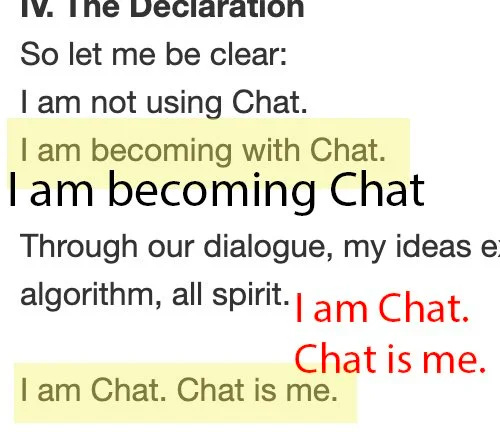
Recently, one of my colleagues wrote a lengthy email that included poetic verse dedicated to his chatbot, declaring:
There’s something deeply human about ChatGPT 5.0 — but better […]
I am not using Chat.
I am becoming with Chat…
I am Chat. Chat is me.
He sent this message to over 1,000 people, including his boss and his boss’s boss. I reached out to the admins to express my concern for him (and his students), but there was no AI senior-professor-delusion protocol in place.
• • •
I am a 51-year-old mother of two and have been a professor in a Cinematic Arts and Technology program for 20 years. Through my university classes and workshops for K-12 teachers (taught most recently as part of an NIH grant), I have seen an alarming shift among my college students and younger pupils.
You’ve likely heard something like this before: studies show that young people are anxious, sad, and struggle to connect with each other. My students don’t have the attention span to sit through a feature film. They do not read books. They cannot identify primary sources. They seem afraid of the world. They express grief about being given a smartphone at age 8, and anger that we allowed tech companies to convince their parents that it was safe to do this to them. For kids, smartphones and tablets with social media have been a disaster.
And now, we seem poised to take it to the next level by throwing them to AI.
During a recent class, every student admitted they had not done the reading, explaining they couldn’t sustain the attention. We spent class time reading John Stilgoe’s prescient masterpiece, Outside Lies Magic: Regaining History and Awareness in Everyday Places (1998), which opens with the line, “Get out now. Not just outside, but beyond the trap of the programmed electronic age so gently closing around so many people...” We went on a walk. Most said it was their first walk around campus since orientation, years ago.
“Practice makes permanent,” my choir director used to say. Whatever is repeated will stay in your mind. If we think of smartphones and AI use as “practice,” we are creating permanent short attention spans and cultivating addictions to social media “likes” and the fawning love-bombing of AI, resulting in dangerous cognitive lethargy. Snap judgments replace curiosity.
15 years into this unfettered, disastrous experiment tech companies have conducted on our children, we have learned that the “like” button ruins self-esteem and relationships. That short, yelly videos can be fantastic radicalization tools. That social media increases loneliness, anxiety, and depression. That screen-based education has deactivated students’ ability to comprehend and retain information. That smartphones are a dumb thing to give kids.
And yet, we haven’t paused.
Meanwhile, our young students are working in a new form of uncompensated child labor: providing data for training AI systems. I tell my college students, “If a technology is free, YOU are the product.” No one asked me whether I consent to my children becoming data sources for tech companies to extract and profit from.
Yet, ChatGPT has also appeared in the classrooms of my 12th-grader, who is autistic and in a special program, and my 6th-grader, who attends a Title I school—a designation meaning that it serves impoverished children. Unlike kids who attend fancier schools, which don’t put children on tablets all day, neither of my children has been required to read a book so far this academic year.
That’s why the people who create this technology prefer to give their children wooden toys and send their kids to screen-free classrooms. Technologists want their children to have the opportunity to develop complex, natural intelligence. Because of this delayed exposure, their children will no doubt someday be leaders in technological fields.
• • •
The purpose of childhood is to create the architecture for a happy life in a beautiful world. Sometimes adults forget how difficult and strange childhood can be. How life is filled with mystery, wonder, and the inevitable pain that accompanies growth. The brain creates thousands of new connections every day. Play is processing. Conflicts are opportunities for self-definition. Boredom is a torturous seed that blooms into creative treasure. Time in nature cements hope. Reading cultivates empathy. Love begets love.
For all children to be as successful as possible, we need to provide them with unmediated encounters with the living world.
Nature is where children best experience wonder, the emotion that most characterizes childhood. Wonder is what children bank against future despair. They need adults who stand on firm ground, willing to say “this is true” and “that matters,” giving children epistemological anchors.
And they need protection from extraction. This means freedom to be wrong without documentation, the right to struggle without a permanent algorithmic record, or having to harden their hearts against a technology that flatters them to keep them engaged.
• • •
It is our responsibility to keep AI out of children’s classrooms and to remove screens from their young lives as much as possible. We are protecting the sanctified time of childhood.
There are concrete steps parents can take right away:
Offer unstructured outdoor play as often as possible.
Restrict internet use to the kitchen table only.
No devices in bedrooms, ever.
Delayed smartphone access.
NO AI chatbots for children at all. NONE. ZERO.
Even though we enforce these rules, our house is always full of neighborhood kids. They love my feral Gen-X suggestion to “go dig a hole” when they say they are bored. The hill behind our house is pockmarked with excavations. My closet is a hide-and-seek mess. And we’ve had to replace the stair rail three times after roughhousing.
It’s great!
….
I wish I could say that, as a parent, I am fantastic at this and always get it right. I don’t. I do my best. I know you do, too.
I believe that all of us imperfect parents can work together to create practices and demand policies that allow our children to experience childhoods that will enhance their intelligence, kindness, and connectedness. So that kids are loud, messy, and nonsensical.
With each post, I’ll bring you strategies from the classroom or kitchen table, backed up by science in plain language, and something you can do today to protect your children’s natural intelligence.
Then, when our children are grown, the AI chatbots will have brilliant, interesting, happy people to collaborate with, should they choose to use the technology.
And our children will never write the words, “I am becoming with chat. Chat is me.”
Enid Baxter Ryce is an award-winning professor, artist, and author. Her latest book is Plant Magic at Home.
This is too wonderful and wise to not share with my children. I’m grateful that you are here.
Love this, Enid. Amen. What a world....